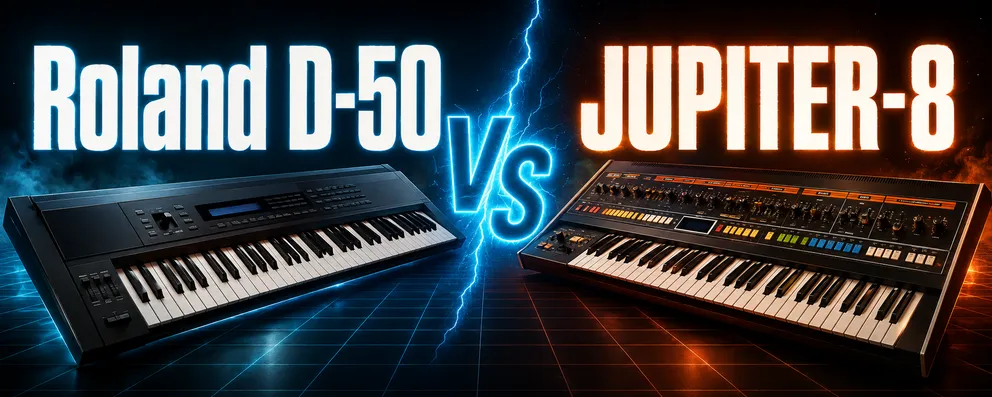
Scroll through Roland Cloud’s plugin lineup and you’ll inevitably run into the same dilemma: “D-50 or JUPITER-8 — which one should I actually buy?”
Both are software versions of iconic Roland hardware, and when they’re both on sale the price gap narrows even further, making the decision harder. The names and the panel layouts even look vaguely similar, but under the hood they’re completely different instruments — that’s what makes this pairing so tricky.
Let’s get this out of the way up front: this isn’t a case of “newer is better.” The JUPITER-8 is a 1981 analog polysynth; the D-50 is a 1987 digital synth. They were born in different eras with completely different sonic philosophies. That’s exactly why the right choice comes down to “what texture do I want to add to my track?” rather than which one is objectively superior.
The short answer: when in doubt, pick based on the texture you want
Here’s the rough breakdown from a DTM production standpoint:
| What you want | Pick this | Why |
|---|---|---|
| Thick analog pads, brass, bass | JUPITER-8 | Classic analog circuitry with 2 VCOs × 8 voices |
| ’80s synth-pop / city-pop-style density | JUPITER-8 | The sonic backbone of countless ’80s classics |
| Transparent bells, crystalline pads | D-50 | The shimmer that comes from LA synthesis attack samples |
| ’90s-ish new age, score, or game music atmosphere | D-50 | The digital sheen typified by the Fantasia-style presets |
| Layering for extra thickness | JUPITER-8 | Unison mode stacks up to 16 oscillators into one voice |
| A top layer to fill the gaps in a mix | D-50 | Stays present and clear even with a sparse note count |
The core axis for choosing between them, in my view, comes down to: do you want to push with analog thickness, or cut through with digital clarity?
So what’s the actual relationship between the D-50 and the JUPITER-8?
First, the premise: these two are not a direct predecessor/successor pair. The JUPITER-8 launched in 1981 as Roland’s flagship analog polysynth — 8-voice polyphonic, with two VCOs per voice. Roughly 3,300 units were reportedly built, and it was an expensive synth even at the time (source: Roland Jupiter-8 – Wikipedia).
The D-50, by contrast, arrived in 1987 — six years after the JUPITER-8, during Roland’s pivot from analog to digital. Its LA (Linear Arithmetic) synthesis engine used 47 types of PCM samples for the attack portion of a sound, combined with subtractive-synthesis tone. Rather than the “hard, flat” character common to digital synths of the era, it’s said to have been groundbreaking for combining a raw, sample-based attack with the sustained richness of synthesized tone (source: Roland D-50 – Wikipedia).
In short, the JUPITER-8 represents “the peak of Roland’s analog era,” while the D-50 marks “the turning point where Roland committed to digital.” They aren’t directly connected in a single product lineage, but they’re best understood as two machines symbolizing two pivotal branch points in Roland’s synth history.
Why the JUPITER-8’s sound still can’t be replaced
The reason the JUPITER-8 is still so highly regarded comes down to one thing: it’s just thick. The undulating harmonics and low-end push that come from its analog circuitry — with two VCOs per voice — are distinctive. Its resonant low-pass filter, switchable between 12dB and 24dB slopes, changes the character dramatically depending on how you carve it.
Unison mode in particular is intense — stacking 16 oscillators into a single voice produces a density that’s genuinely hard to replicate with modern soft synths. It was used on synth brass parts for Queen albums and Michael Jackson’s Thriller (source: Roland Jupiter-8 – Wikipedia), and it’s practically synonymous with the thick, progressive-leaning synth-pop sound of the 1980s.
Modern virtual-analog plugins can aim for a similar direction, but the “character baked into the circuit’s quirks” that’s unique to the JUPITER-8 tends to be a longer road to reach than it looks when you try to chase it deliberately.
Why the D-50’s sound is said to have “defined an era”
The reason the D-50 is still talked about today runs in exactly the opposite direction from the JUPITER-8. By using PCM samples for the attack, it achieved a “metallic, crystal-clear shimmer” that analog synths of the time simply couldn’t produce.
Its signature preset, “Pizzagogo,” is famously associated with Enya’s music, and presets like “Fantasia” and “Digital Native Dance” were used across numerous late-’80s to ’90s works by artists including Prince, Sting, and Jean-Michel Jarre (source: Roland D-50 – Wikipedia).
What’s interesting about the D-50’s sound is that it keeps its outline clear even with a sparse note count. Where the JUPITER-8 attacks with thickness, the D-50 excels at fitting neatly into the gaps of a track using less information. It’s still valued in new age, ambient, film/game scoring for exactly this clean, cutting-through quality.
Comparing the D-50 and JUPITER-8: tone and features
| Comparison point | D-50 | JUPITER-8 |
|---|---|---|
| Original hardware release year | 1987 | 1981 |
| Synthesis method | LA synthesis (PCM attack + subtractive) | Analog subtractive |
| Sonic direction | Transparent, crystalline shimmer | Thick, undulating analog character |
| Voice structure | 1 sound = 2 tones × 2 partials each | 1 voice = 2 VCOs, 8-voice polyphony |
| Signature feature | Built-in chorus/reverb, virtual PG-1000 controller | Unison mode stacking up to 16 oscillators |
| Preset tendencies | Fantasia/Pizzagogo-style bells and pads | Brass, pads, thick basses |
| Hardware-era price bracket | Premium (cutting-edge digital flagship) | Premium (top-tier analog flagship) |
As the table makes clear, these are fundamentally different synthesis methods to begin with. This isn’t a comparison you can settle with a simple “newer means more capable” — that’s worth keeping in mind from the start.
Rules of thumb beginners should keep in mind when choosing
- Don’t assume “digital = newer = better.” The D-50 came after the JUPITER-8, but it’s not a substitute for the JUPITER-8’s analog thickness. They’re simply aiming for different textures.
- Don’t choose based on preset count alone. Both feel “ready to go” straight out of the box with their presets, but if you haven’t decided what role the sound should play in the overall track, you won’t get full value out of either.
- Don’t stack the two in the same role. Layer a thick pad from both the JUPITER-8 and D-50 at once and the tones tend to clash and turn to mush. The basic approach is to split roles by frequency range — JUPITER-8 as the low-mid foundation, D-50 as the mid-high top layer.
Three real production scenarios that show how to use each
City pop / ’80s boogie: lead with the JUPITER-8
If you’re after thick synth bass, undulating pads, or brass-style leads, reach for the JUPITER-8 first. Thicken up a bassline with unison mode, or lay a pad down as a chordal foundation, and you’ll quickly get an arrangement with that dense ’80s feel.
New age / ambient / film scoring: lead with the D-50
If you want transparent bells, sustained pads, or crisp crystalline tones, the D-50 is the one to reach for. It holds its presence even with a sparse note count, which makes it well-suited to the role of “building atmosphere” in quieter moments. It’s also strong at sitting thinly behind vocals or a lead instrument without getting in the way.
Synthwave / retro-futurism: split the roles and use both
Build the foundation — bass, pads, brass — with the JUPITER-8, then layer arpeggios or bell-like top parts with the D-50. By splitting frequency ranges — low-mid with the JUPITER-8, mid-high with the D-50 — you can land both the ’80s thickness and the transparency at the same time.
What it’s like to actually use them
The JUPITER-8 strikes me as the kind of sound that “just feels good the moment you hit a note.” Nudging the filter open and closed changes the expression so noticeably that you get ideas just from turning the knobs. Speaking as a guitarist, it’s a bit like the feeling of riding the gain on a distortion pedal up and down.
The D-50, by contrast, tells you from the very first note that this is a sound you build by subtraction rather than addition. Add more notes and it gets cluttered fast — it constantly tests you on how to build space with fewer elements. It shines less as the star of the track and more as the thing that defines the track’s scenery.
Personally, I’ve settled into using them this way: JUPITER-8 for tracks I want to push with thickness, D-50 for tracks where I want to carve out space. That split has never let me down.
Pros and Cons
D-50 Pros
- Strong, transparent bells and pads that fill gaps in a track without getting in the way
- Keeps its outline clear even with a sparse note count, so it’s hard to lose in a mix
- Built-in chorus/reverb baked into the presets, so it sounds finished even used solo
D-50 Cons
- No substitute for thick analog sound
- Its preset character is distinct enough that it has limited use in tracks that don’t suit its direction
- Can feel a bit tricky to handle until you get used to the “make it work with fewer notes” mindset
JUPITER-8 Pros
- Covers the analog gold standard — thickness, movement, presence — in a single instrument
- Layering with unison mode produces a density that’s hard to get from modern plugins
- A go-to for building the foundation of ’80s synth sounds: brass, pads, bass
JUPITER-8 Cons
- Falls a step behind when you need transparency or a clean cut-through tone
- Stack too much and the low-mids can saturate quickly in a modern mix
- Chasing a shimmering digital character requires a different sound source
Where each one fits by genre
For city pop / funk, build the foundation with the JUPITER-8’s bass and pads, then lightly dust the gaps with D-50 bells for a sound that balances ’80s thickness with modern clarity.
For ambient / new age, the D-50 takes the lead. Layer long-attack pads thinly and open up the space with reverb, and that alone can be enough to complete a track’s mood.
For synthwave / retro-futurism, pairing the JUPITER-8’s arpeggiated bass with the D-50’s crystalline leads is the classic move. The contrast between thickness and shimmer becomes the genre’s charm.
For film and game scoring, use the D-50 for scene transitions and quiet moments and the JUPITER-8 for the big, dramatic ones — the split helps you build temperature contrast across the piece.
Who is each one for?
JUPITER-8 fits you if:
- You want thick analog sound, right now
- You’re going for that ’80s city pop, funk, or prog-adjacent texture
- You want to lock down the foundation of a track — bass, pads, brass — with analog thickness
D-50 fits you if:
- You’re looking for transparent top-end sounds for new age, ambient, or scoring work
- You’re curious about building sounds by carving out space with fewer notes
- You want to bring late-’80s to ’90s digital sound into your tracks
Current sale pricing
As of 2026-08-09, Roland Cloud has the following sale pricing:
- D-50: Regular ¥25,970 → Sale price ¥12,400
- JUPITER-8: Regular ¥34,680 → Sale price ¥17,791
The sale runs through August 31, 2026. Both discounts are substantial, so if you already know which direction you’re headed, it’s worth grabbing during the sale. If you want both, this is also a reasonable moment to pick them up together.
Prices and sale periods are subject to change — always check the official Roland Cloud site for the latest information before purchasing.
FAQ
Q. Which is more beginner-friendly, the D-50 or the JUPITER-8?
A. In terms of how intuitive the sound design is, the JUPITER-8 is probably the easier entry point. Turning the filter and resonance produces such clear, audible changes that it’s a great way to get a feel for basic synth operation. The D-50’s presets are polished enough to use as-is even as a beginner, but building a patch from scratch requires understanding the specifics of LA synthesis.
Q. If I already have the JUPITER-8, do I still need the D-50?
A. Not necessarily “need,” but it’s not redundant either. The JUPITER-8 excels at thickness and movement, while the D-50’s clear, transparent top layers are a different kind of appeal entirely. Splitting roles — JUPITER-8 for the foundation, D-50 for the top — is a perfectly reasonable approach.
Q. If I already have the D-50, do I still need the JUPITER-8?
A. You can make plenty of tracks with the D-50 alone, but you’ll likely feel something’s missing on tracks that call for thick analog bass, pads, or brass. If you’re after that ’80s-style thickness, the JUPITER-8 should be a higher priority.
Q. Is it still worth using these compared to modern virtual-analog soft synths?
A. I think so. Modern synths generally offer more sound-design flexibility, but the D-50 and JUPITER-8 each carry the hardware-specific texture and preset character of their respective eras. Think of them less as tools to “modernize” your sound and more as instruments for adding an “era-specific atmosphere” that’s hard to get from current sound sources alone.
Q. What about DAW compatibility?
A. Both the D-50 and JUPITER-8 on Roland Cloud support VST3, AU, and AAX. They should work without issues in any major DAW.
Conclusion
If you’re torn between the D-50 and the JUPITER-8, the simplest way to decide isn’t “which one is better” — it’s “what texture do I want to add to my track?”
The JUPITER-8 offers thickness, movement, and density from its analog circuitry and unison mode. The D-50 offers transparency, shimmer, and clean cut-through from its LA synthesis engine and built-in effects. Rather than competing with each other, these two are arguably worth owning together precisely because their roles are near-opposites.
Reach for the JUPITER-8 when you want to build a thick foundation, and the D-50 when you want to carve out space in your track. Neither is meant to replace your current sound library — think of either one as an addition that brings “era-specific texture” to modern production, and it should open up your options considerably.
If you want to explore more synth plugins, check out our Roland JV-1080 review, Roland JUNO-60 review, and Roland ZENOLOGY PRO review. For more synth reviews, see our synthesizer plugin review roundup.