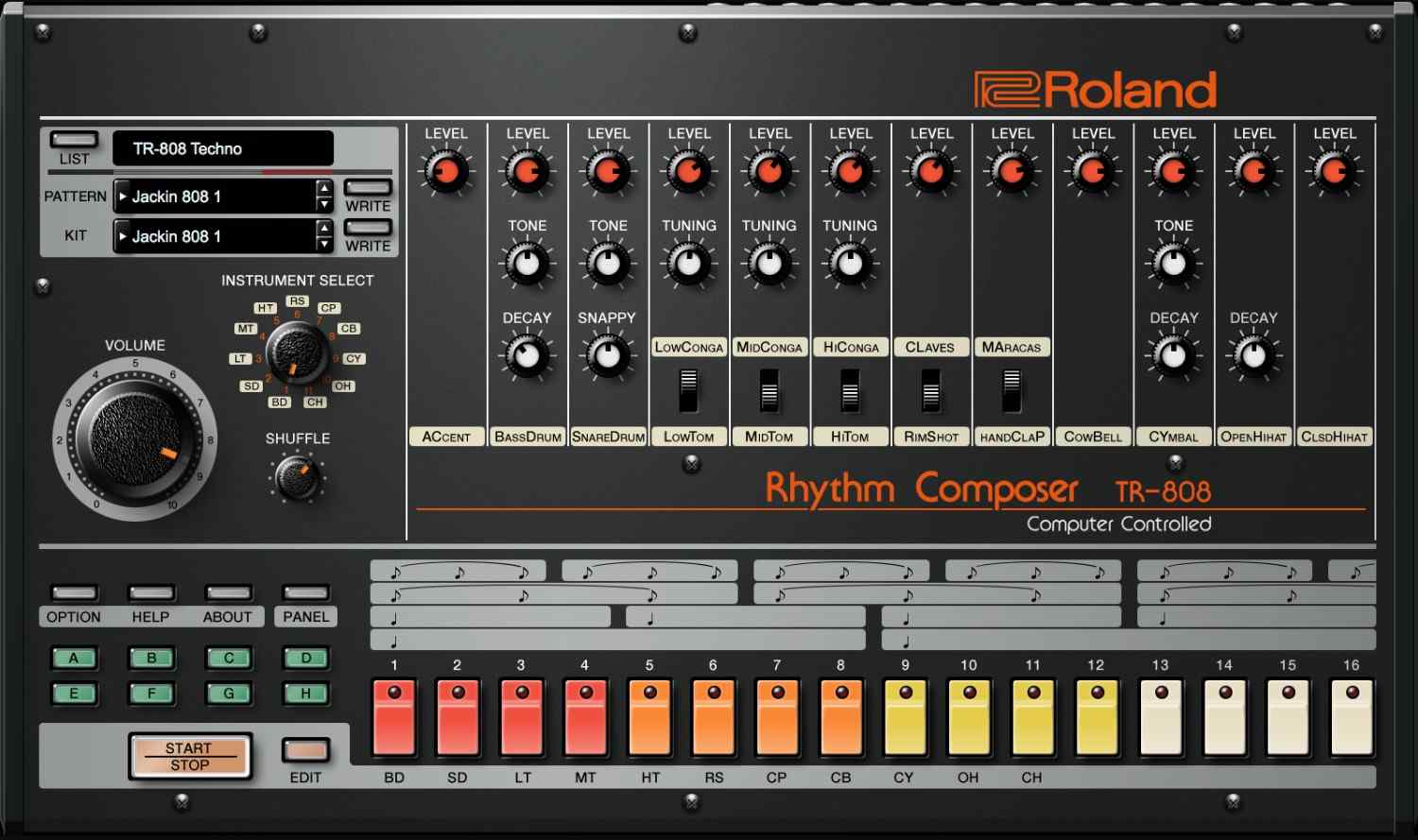
Once you start looking for TR-808 sounds, the list of options gets large very quickly: Roland’s official software version, 808 emulations, sample instruments, and bass instruments made for Trap production. It is easy to assume that any plug-in with an 808-style interface will lead to similar results, but the role you need during production changes dramatically from one product to another.
Some producers want to program electro or techno patterns while adjusting hardware-style parameters. Others want to create long, key-matched 808 bass notes for a Hip Hop track as quickly as possible. Others want to load kick, clap, and hi-hat sounds with an already polished 1980s character. All three are looking for an “808,” but they are really looking for different instruments.
Here is the short version. Roland Cloud TR-808 and D16 Nepheton 2 are the central choices when you want the full TR-808 inside a DAW: choose Roland for the official reference point, or Nepheton 2 for deeper modern sound design around the 808 concept. AudioRealism ADM1x is a better fit when you want several classic drum machines in one instrument. UVI Prime 8+ works well when you want punchy, production-ready samples. For getting the low end of a Trap track into shape quickly, a bass-focused instrument such as Initial Audio 808 Studio 2 makes more sense.
The Quick Answer: The Best TR-808 Plug-In for Each Goal
| What you want to make | Best fit | Why it fits |
|---|---|---|
| Use Roland’s own TR-808 inside a DAW | Roland Cloud TR-808 | Uses the original workflow as its starting point, with 11 voices and sequencing for each part |
| Shape 808 sounds for techno or electro while building patterns | D16 Nepheton 2 | 17 synthesized instruments, built-in effects, and expanded sequencing tools |
| Keep 808, 909, and 606 sounds in one plug-in | AudioRealism ADM1x | Models three classic drum machines and can combine them with sample playback |
| Start with thick, processed 808 sounds immediately | UVI Prime 8+ | Multi-sampling, channel processing, and a large pattern library create fast production-ready starting points |
| Push 808-flavored drums into a more individual sound | Softube Heartbeat | Drum synthesis, Auto Layer Machine, and built-in effects support deeper transformation |
| Layer 808 with other classic drum machines | EastWest DrumX | Samples ten drum machines including the TR-808, with layering and groove-building tools |
| Make Trap or Drill 808 bass the main element | Initial Audio 808 Studio 2 | A dedicated 808 bass synth with sub oscillator, sampler, and modulation |
The key distinction is that most products in the upper rows are drum machines, while 808 Studio 2 is a bass synth. If you want the modern sound of a TR-808 kick stretched into a bass line, you may not need every drum-machine voice. If you want the rhythmic character of claps, cowbells, hi-hats, and congas as well, a bass-only instrument cannot cover the whole job.
Why Choosing a TR-808 Plug-In Gets Confusing
A TR-808 Emulation and an 808 Bass Instrument Are Not the Same Thing
The TR-808 is not only a kick drum. Its rounded, long-decaying kick, dry snare, distinct clap, metallic cowbell, grainy hi-hats, and the combination of toms and congas all contribute to a complete rhythmic character. The way it invites you to program repeating 16-step patterns is part of its appeal as well.
By contrast, the sound called an “808” in Trap and Drill is usually the low-end star of the song. It is tuned to the key, played as a bass line, often shaped with long decay, pitch movement, distortion, harmonics, and sidechain processing. The source may be a TR-808 kick, but the finished role is much closer to a bass instrument than a drum sound.
That distinction explains two common disappointments. Buying a TR-808 plug-in does not automatically give you the modern low end you were hoping for, and buying an 808 bass synth does not automatically give you a classic electro beat with the right clap, cowbell, cymbal, and hi-hat character. Neither result means you chose a bad product. The problem is usually that the intended musical role was not separated at the beginning.
The Sound Engine Changes Your Starting Point for Sound Design
808-related software generally falls into three approaches.
| Sound engine | Examples | What it does well during production | What to keep in mind |
|---|---|---|---|
| Circuit modeling or synthesis | Roland Cloud TR-808, Nepheton 2, ADM1x | Lets you adjust tuning, decay, and accents for each song | Final weight and polish may still need mixing or processing |
| Multi-sampling | UVI Prime 8+, EastWest DrumX | Gives you recorded and processed character quickly | Radical changes away from the source character are not the main strength |
| Dedicated 808 bass synthesis | Initial Audio 808 Studio 2 | Makes it easier to build pitch-following low end, distortion, and sub content | It is not designed to recreate the complete TR-808 drum layout |
Comparing only “which one sounds most like the original” can hide the production workflow that each product supports. Do you want to change the sound while you make the pattern? Do you want to choose an already finished-feeling hit? Do you want to perform a sub-bass part in the piano roll? Choose the engine first, and the purchase decision becomes much clearer.
A Built-In Sequencer Changes How Fast You Can Write
The 16-step workflow associated with the TR-808 is more than an input method. It gives you a visual way to decide where the kick drops out, how often the clap repeats, and where hi-hat density should increase. A DAW piano roll can create the same notes, but a drum-machine sequencer keeps accents, shuffle, and pattern switching close together, making it easier to experiment with the movement of a repeating groove.
Sequencer-equipped instruments suit producers who want to begin from the beat itself. If your MIDI is already written and you only need a better sound source, individual outputs and easy per-part processing may be more important than an internal sequencer.
Roland Cloud TR-808: For Producers Who Want the Official Reference Point
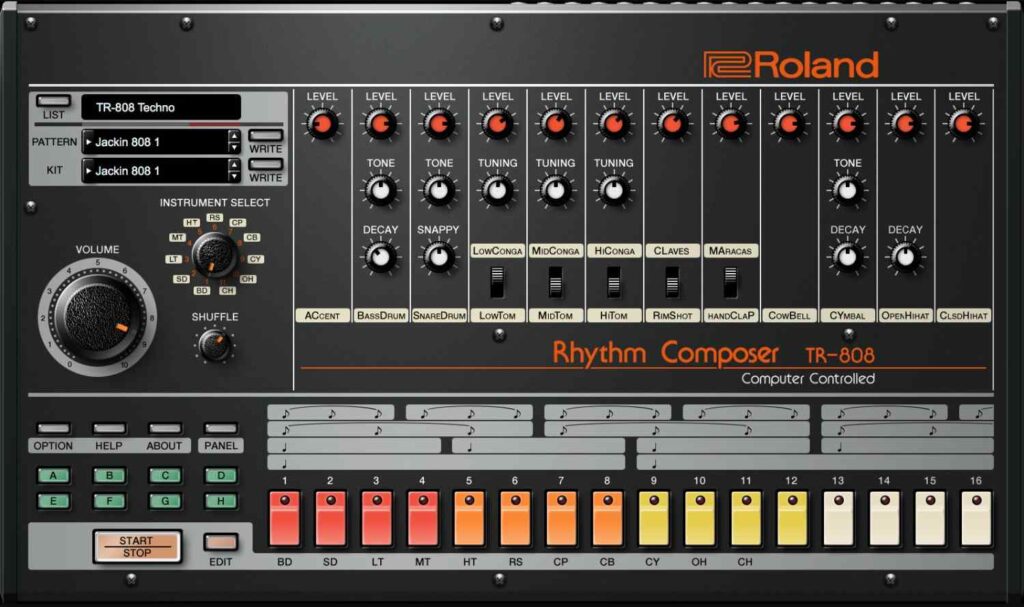
Roland Cloud TR-808 is the most direct way to bring the name, layout, and design logic of the TR-808 into a DAW. It centers on 11 voices, 11 instrument parts, and 16-step pattern programming, with A through H variations available for a pattern. Kick, snare, hi-hats, toms and congas, rim shot and claves, clap and maracas all sit within the familiar TR-808 part structure.
The main reason to choose Roland Cloud TR-808 is not the sheer number of features. It is the ability to work from a clear reference point for what an 808 is. You can explore clap decay, open-hi-hat length, cowbell placement, and accent patterns in the context of the original instrument. That makes the plug-in particularly useful for building foundations for electro, early Hip Hop, Miami bass, synth-pop, and techno.
If your goal is to force a kick into the extreme bass role used in Trap, an official-style emulation is rarely the whole solution. Add saturation, clipping, EQ, pitch treatment, and timing decisions after the instrument. Roland Cloud TR-808 is not an all-purpose modern 808 bass generator; it is the right tool when you want to start from the TR-808’s musical framework and build your own processing chain around it.
Roland Cloud TR-808 Works Best For
- Learning the original part layout and 16-step feel of the TR-808
- Using claps, cowbells, and tom/conga parts alongside the core kick and hats
- Building changing one-bar patterns for electro and techno repetition
- Sending individual parts into separate DAW channels for mixing
D16 Nepheton 2: For Shaping the 808 Around Your Track
D16 Nepheton 2 is a drum machine built around 17 synthesized percussion instruments modeled after the TR-808. Instead of treating the sound as a fixed sample, it makes generation and parameter adjustment central to the workflow. That makes it easier to adapt kick length and contour, or the character of hats and cymbals, to the direction of a particular song.
Built-in effects, pattern programming, MIDI map editing, multiple outputs, and more than 1,200 factory presets and patterns move Nepheton 2 beyond a simple vintage recreation. It suits situations where you want to grow variation inside a techno loop, add short trigger-like pulses to an electro arrangement, or bring an 808 kick forward without losing its underlying character.
Nepheton 2 becomes especially useful when you do not want an 808 to remain a nostalgic preset. If kick and bass collide, shorten the kick decay to fit the tempo and the bass-note length before reaching for large EQ moves. If hi-hats feel harsh, inspect decay and pattern density before turning the level down. A synthesis-based drum machine lets you correct the source of the sound before trying to repair the result with processing.
Nepheton 2 Works Best For
- Dialing in 808 kick decay and character for each track
- Building evolving repetition in techno, electro, breaks, and other dance music
- Designing patterns and sounds together instead of choosing fixed 808 samples
- Keeping a drum-machine workflow complete with individual outputs and internal processing
AudioRealism ADM1x: A Classic Drum-Machine Environment Beyond the 808
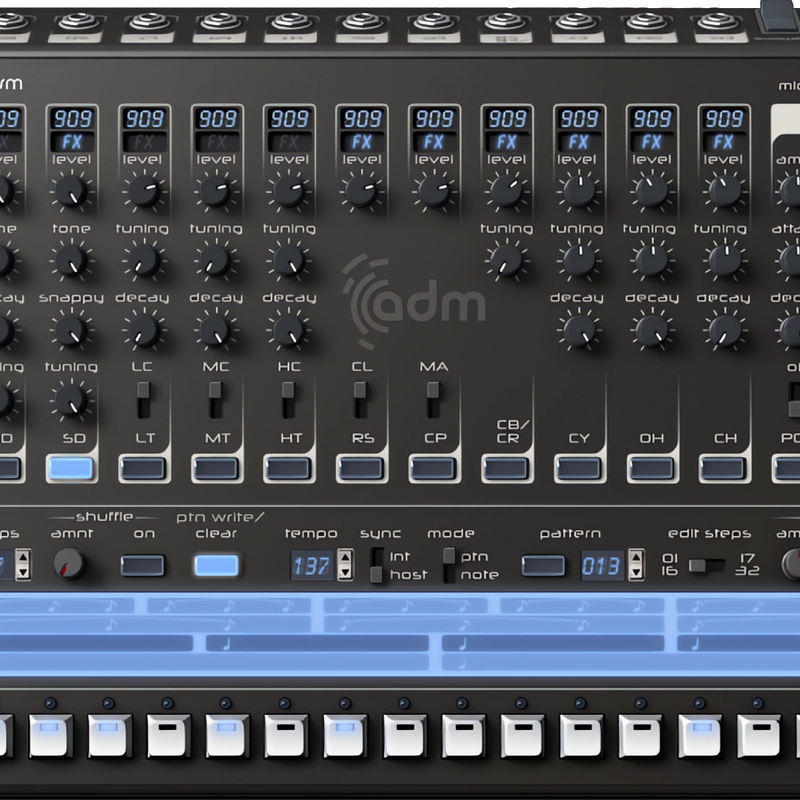
AudioRealism Drum Machine, or ADM1x, combines circuit models of the TR-606, TR-808, and TR-909 in one instrument. Its 25 drum generators and four PCM players let you use an 808 kick and hi-hat alongside a 909 attack or lighter 606 percussion. You can also trigger your own samples from the built-in step sequencer, putting classic drum-machine sounds and more modern material inside the same pattern.
If you want to study one 808 deeply, Roland Cloud TR-808 or Nepheton 2 gives you a more focused interface. ADM1x is designed for a different question: how can 808, 909, and 606 sounds work together inside the same track? An 808 kick with a 909 hi-hat, or a 606 percussion accent, can be tested without loading multiple instruments.
Buying individual drum machines one at a time can scatter sound and pattern management across a project. ADM1x is better suited to producers who want one production environment for the full family of classic electronic drum characters.
ADM1x Works Best For
- Switching between 808, 909, and 606 sounds by section or genre
- Combining personal samples with analog-style drum sounds in one sequencer
- Moving across house, techno, electro, and EBM production
- Learning classic drum-machine foundations without collecting many separate plug-ins
UVI Prime 8+: For Production-Ready 808 Presence Without Starting From Zero

UVI Prime 8+ is a classic 808-style drum instrument based on multi-sampled sounds captured through a Class-A signal chain. It includes more than 140 presets, more than 1,100 MIDI patterns, per-channel reverb, delay, drive, low-pass/high-pass filtering, and multi-output routing.
The attraction of Prime 8+ is not that it tries to model every circuit decision in real time. It takes you quickly toward the feeling of a record-ready 808 sound that already has presence. If you find it tiring to construct kick and clap character from scratch in a circuit-modeling instrument, Prime 8+ can reduce the time spent choosing sounds. Load a pattern, replace the parts you need, and begin mixing through individual outputs.
The trade-off is that producers who want to examine every circuit parameter or unit-specific variation may prefer a synthesis-based emulation. Prime 8+ favors recorded weight, punch, and a convenient starting point over the widest possible range of source-level sound design.
Prime 8+ Works Best For
- Finishing 808 drum sound selection quickly
- Using thick one-shots in pop, R&B, Hip Hop, and electro
- Starting a rhythm from built-in patterns
- Beginning with sounds that already sit close to a finished mix
Softube Heartbeat: For Turning 808 Flavor Into Your Own Drum Sound
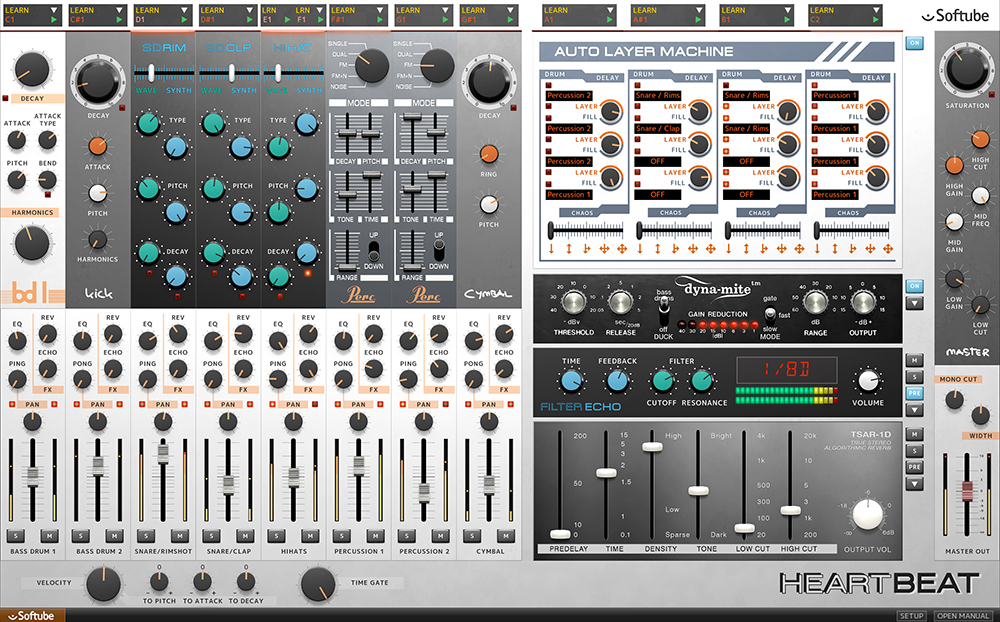
Softube Heartbeat is an eight-channel drum synth built primarily around analog modeling. It is not a plug-in intended as a complete, one-to-one TR-808 recreation. Instead, it starts from the weight and electronic contour associated with vintage drum machines, then gives you drum synthesis, an Auto Layer Machine, reverb, compression, filter echo, and output saturation to create something much more individual.
Heartbeat’s Auto Layer Machine can layer sounds or trigger patterns. You can add a short noise layer to a clap, blend another layer behind a kick, or create movement at the end of a bar with filter echo. The workflow makes sense for producers who want to keep some 808-like outline while pushing the drum sound toward a version that only makes sense within their own track.
If you want to learn the original instrument layout and classic programming method, Heartbeat is not the clearest first reference. If you already understand basic TR-style sound roles and want more freedom through layering and internal processing, Heartbeat opens a much larger design space.
EastWest DrumX: For Building Grooves by Layering the 808 With Other Classics
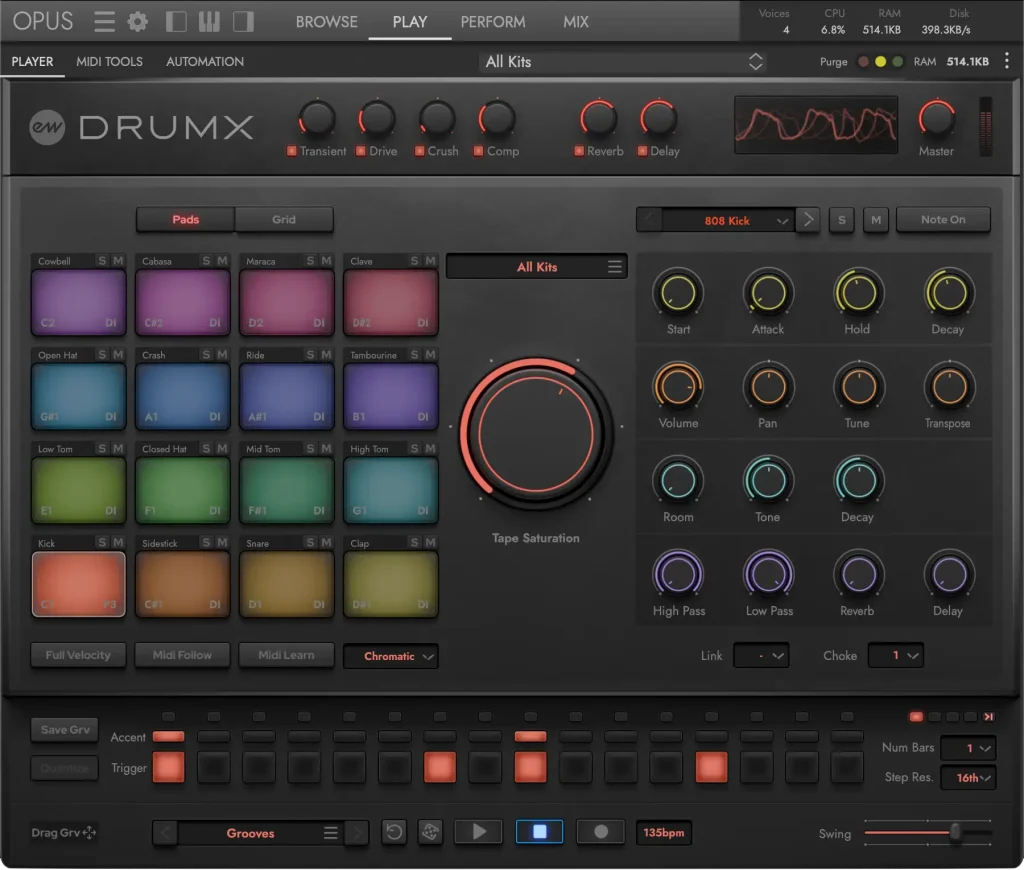
EastWest DrumX is a sample-based groove instrument containing ten drum machines, including the TR-808, TR-909, TR-606, LinnDrum, LM-1, DMX, and SP-12. TR-808 sounds are captured with up to four round-robin variations, and the kick offers Tone and Decay control, the snare offers Tone and Snap control, while toms and congas have pitch control.
The defining value of DrumX is not the isolated recreation of one 808. It is a design that expects combinations such as an 808 kick, a 909 snare, and a LinnDrum hi-hat. Its 16-pad sound editing, step sequencer, swing, quantize, randomize, tape saturation, room mics, and effects chain make it possible to use groove itself as the start of a song instead of simply listing historic drum-machine sounds.
The amount of material can feel excessive if you only want the self-contained identity of a single 808. If you want to layer several classic machines for pop, R&B, Hip Hop, or dance music, DrumX gives you ready-to-use material and substantial editing depth in one place.
For Trap 808 Bass, Think of 808 Studio 2 as a Separate Category
Initial Audio 808 Studio 2 is a bass synth designed for everything from deep, warm 808s to distorted, aggressive low end. Its three oscillators, sampler, sub oscillator, and drag-and-drop modulation focus on playing low frequencies in the key of the song.
A Trap 808 is not finished by simply turning up a kick. It needs to work as a pitched bass line, which means choosing a sound that fits the key, adding enough harmonics to remain audible on small speakers, deciding how long it should sustain, and fitting its timing around the drums. A bass-focused instrument such as 808 Studio 2 keeps the work centered on writing low-end notes in the piano roll.
At the same time, 808 Studio 2 does not recreate the TR-808 clap, cowbell, cymbal, or hi-hat. If a Trap track needs both a bass-led 808 and a classic drum-machine character, use a split setup: 808 Studio 2 for low end, and Roland Cloud TR-808 or Nepheton 2 for rhythm parts. That division keeps each instrument focused on the role it handles best.
How to Choose When You Are Still Unsure: Three Questions
1. Do You Need the Whole Drum Machine or Only the Low End?
For the full rhythmic identity of 808 claps, hi-hats, and percussion, look at Roland Cloud TR-808, Nepheton 2, ADM1x, Prime 8+, or DrumX. For a Trap bass line alone, prioritize a bass-focused instrument such as 808 Studio 2.
2. Do You Want to Generate and Fine-Tune the Sound, or Choose a Finished Starting Point?
For detailed control over kick decay, hi-hat release, and accent behavior, Roland Cloud TR-808, Nepheton 2, and ADM1x are better fits. For fast access to already weighty and polished sounds, Prime 8+ and DrumX are faster starting points.
3. Do You Want to Go Deep on One 808 or Combine Several Machines?
For a deep TR-808 focus, choose Roland Cloud TR-808 or Nepheton 2. For moving between 808, 909, and 606, choose ADM1x. For layering the 808 with LinnDrum, DMX, and SP-12 sounds, DrumX is the better match. The answer is not about a universal ranking. It depends on the relationship you want between the drum sounds in the song.
Basic Settings for Making TR-808 Sounds Work in a Track
Adding a TR-808-style instrument does not automatically make a beat sound convincing. Give each part a clear role and even a vintage sound can work inside a current production.
| Part | Decide this first | Common mix problem | Starting point for adjustment |
|---|---|---|---|
| Kick | Tuning, decay, and accent | The low end swells against the bass | Shorten decay or alternate the kick and bass entrances |
| Clap / snare | Placement and tail length | Too much upper-mid energy becomes tiring | Review hit count and decay before adjusting level |
| Closed hi-hat | Sixteenth-note density | The loop sounds stiff or rushed | Leave gaps and separate accents |
| Open hi-hat / cymbal | Where the tail should extend | Covers vocals or upper instruments | Limit use to bar endings and section transitions |
| Cowbell / conga | Its role as a phrase | The rhythm starts to feel crowded | Give it one job: fill a melodic gap or define a rhythmic hook |
An 808 kick does not become better simply because it is longer. If a track contains sustained bass notes and a long kick decay, the timing of the low-end events can collide before the overall level even becomes the problem. Shorten the kick, move the bass entrance slightly, and check the tuning relationship between kick and bass. That three-step process often works better than endlessly cutting low frequencies with EQ.
What to Check Before Buying
- Decide whether you need a full TR-808-style drum machine or an 808 bass instrument
- Decide whether you want to write inside a built-in sequencer or a DAW piano roll
- Decide whether 808 alone is enough, or whether you also need 909, 606, LinnDrum, and other machines
- Decide whether you want separate outputs for mixing or a fast stereo workflow
- When a demo is available, compare the same MIDI pattern across products using kick, clap, and hi-hat
With 808-related instruments, comparing the same four-bar MIDI pattern is often more useful than browsing ten presets. Listen to kick decay, clap placement, hi-hat top end, and the feel created by accents. That approach makes it much easier to identify the instrument your own track actually needs.
Frequently Asked Questions
Which Plug-In Is Best for the Most Authentic TR-808 Character?
Roland Cloud TR-808 is the most useful starting point. It suits producers who want Roland’s original part layout, control philosophy, and sequencing inside a DAW. Compare it with Nepheton 2 afterward if you want to hear how a more expanded production-oriented approach changes the workflow.
Should I Choose D16 Nepheton 2 or Roland Cloud TR-808?
Roland Cloud TR-808 suits producers looking for a direct reference to the TR-808 as an instrument. Nepheton 2 suits producers who want to begin with the 808 character but reshape it for a specific track using internal effects and expanded pattern tools. Choose Roland to learn the original context; choose Nepheton 2 when sound-shaping range inside a modern production matters more.
Is a Trap 808 the Same as a TR-808 Plug-In?
The origin is related, but the musical role is different. A Trap 808 is a bass line played melodically in the low end. You can make one with a TR-808 plug-in, but a dedicated 808 bass instrument can be faster when you need pitch control, distortion, sub content, and long sustain.
Is It Fine to Start With a Free 808 Plug-In?
Yes, if your aim is to learn the basic sound or 16-step programming feel. For a main instrument you intend to keep using in finished projects, availability, Apple Silicon support, multi-output routing, preset management, and update stability can vary widely. Comparing current products with demo versions is usually the safer long-term route.
Can I Use an 808 Kick and a Regular Bass at the Same Time?
Yes, but overlapping them at the same length can make the low end muddy. Shorten the kick while letting the bass sustain, create a brief gap in the bass when the kick lands, or give the two parts different octave roles. The important decision is which part owns the low end at each moment.
Conclusion: Choose the Role You Need the 808 to Play
The first decision in choosing a TR-808 plug-in is not a ranking of authenticity. It is deciding what role the 808 should play in the song.
Roland Cloud TR-808 fits producers who want the official reference point inside a DAW. D16 Nepheton 2 fits producers who want to reshape 808 sounds into modern beats. ADM1x fits producers who want to move across 808, 909, and 606 sounds. Prime 8+ fits producers who want to start from polished sample weight. Heartbeat fits producers who want to create original electronic drums rather than strictly recreate an 808. DrumX fits producers who want to construct grooves by layering several historic machines. 808 Studio 2 fits producers who want Trap low end to be the central musical voice.
— For a first purchase, Roland Cloud TR-808 or D16 Nepheton 2 is the clearest route when you want the full TR-808 sound, while 808 Studio 2 is the clearer route when you want an 808 bass line. In your next session, load the same four-bar MIDI pattern into the candidates and compare the role of the kick, clap, hi-hat, and low end.