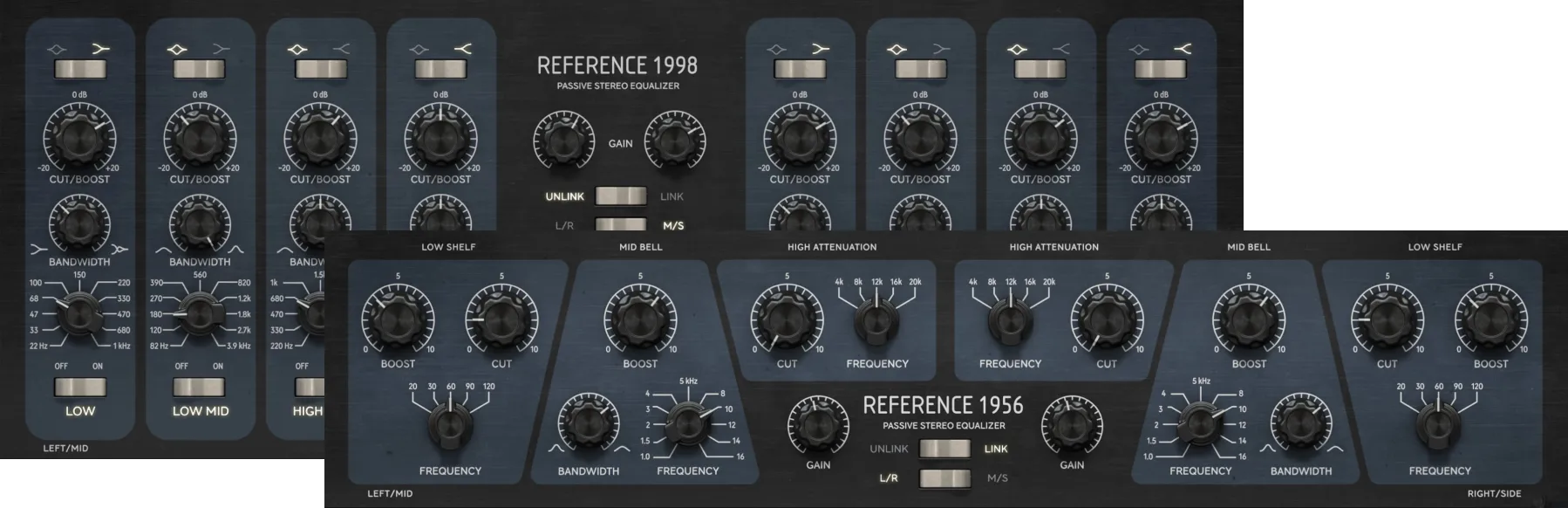
You want an EQ with character on your mix bus. You want richer low end or smoother top end. Then you see Softube Reference 1956 Equalizer and Reference 1998 Equalizer. Their appearance is similar, both sit in the passive tube EQ category, and the buying decision suddenly becomes less obvious.
Neither plug-in is a surgical EQ for locating one narrow problem frequency. Both are broad-stroke tone shapers that can change the temperature, density, and sense of forward motion in a track.
The short answer is simple. Reference 1956 Equalizer is the better choice when you want to reshape the overall posture of a mix with broad, natural moves. Reference 1998 Equalizer is the better choice when you want tube warmth, stronger color, and more density in a mix or master.
There is no higher or lower model here. The useful question is what type of change your song needs.
The Short Answer: Choose by the Change You Want to Hear
| Comparison point | Reference 1956 Equalizer | Reference 1998 Equalizer |
|---|---|---|
| Core job | Reshapes the overall posture of a mix with natural broad strokes | Adds density through warmth, saturation, and color |
| Circuit character | Minimum-phase passive EQ for large tonal moves | Tube-driven design with four parallel passive EQ bands |
| Main strength | Mid/Side, independent channel gain, and Headroom for balance control | Shelving curves, low-end shaping, and a bold color character |
| Best applications | Mix bus, mastering, and broad stereo-source shaping | Mix bus, mastering, drum bus, and character building |
| Do not expect | Surgical removal of narrow resonances | Completely transparent corrective processing |
“I want fuller low end” is not enough information to choose between the two. Choose 1956 when you want to alter the overall balance without losing the shape of the song. Choose 1998 when you want more temperature, presence, and a slightly rougher musical personality.
Reference 1956 Equalizer sale >>
Reference 1998 Equalizer sale >>
◯1956 &1998 bundle
Reference Equalizers Bundle >>
How Reference 1956 and Reference 1998 Relate to Each Other
Reference 1956 Equalizer and Reference 1998 Equalizer both use the appeal of passive circuitry and tube output stages. Compared with a modern parametric EQ built around op-amps or transistors, passive EQ designs are especially good at making wide tonal moves sound natural.
The shared category does not make the two plug-ins interchangeable. Reference 1956 Equalizer centers on a minimum-phase passive design and broad, musical shaping. Reference 1998 Equalizer centers on four parallel passive bands and tube drive, making warmth, saturation, and color a more active part of the sound.
Think of Reference 1956 Equalizer as the tool that deals with the skeleton of tonal balance. Think of Reference 1998 Equalizer as the tool that adds muscle, texture, and color to that skeleton. The distinction makes the buying decision much clearer.
Reference 1956 Equalizer: Broad, Natural Tonal Movement
Reference 1956 Equalizer comes alive when you want to move the whole character of a track rather than carve a narrow frequency. If a mix feels lean, it can support the lower spectrum. If a track feels dark, it can add a more open top end. The important idea is broad movement, not microscopic surgery.
Why a Minimum-Phase Passive EQ Works Well for Broad Strokes
Minimum-phase processing is a low-latency approach compared with linear-phase processing. In Reference 1956 Equalizer, the passive curves can make large adjustments on a mix bus or instrument bus while retaining a musical sense of movement.
Imagine a song where acoustic guitar and piano overlap and the entire production feels slightly underweight. A narrow low-mid boost can add size, but it can also expose boxiness. Reference 1956 Equalizer is better suited to shifting the low-end center of gravity across a wider range, changing the perceived posture of the mix instead of highlighting one small area.
Mid/Side and Independent Gain for Stereo Balance
Reference 1956 Equalizer includes Mid/Side processing, independent left/right gain controls, and a Headroom control. Mid/Side processing separates the center information, including kick, bass, and lead vocal, from side information such as guitars, synths, and reverb.
That makes Reference 1956 useful when the center feels too heavy, when the sides are overly bright, when left/right balance needs refinement, or when a master needs more stable low end without losing width. Mid/Side is not only a dramatic widening tool. Its most musical use is clarifying the role of the center and the sides.
The Headroom control is useful when you want more of the transformer’s thick low-end character. Instead of pushing EQ gain endlessly to create weight, you have another way to change the perceived density of the low spectrum.
1956 Makes Big Changes Without Fighting the Song Flow
The appeal of Reference 1956 Equalizer is how easily it can change the overall view of a song. A small shelf move or a small amount of low-end support can alter the arrangement and mix impression more than the numeric settings suggest.
There is an important limitation. A broad EQ is not the fastest answer when the issue is one narrow resonance, nasal vocal tone, or a sharp hi-hat peak. Deal with a targeted problem using a precise or dynamic EQ first. Reference 1956 Equalizer works best after problem frequencies are under control and the mix needs a clear musical direction.
Reference 1998 Equalizer: Density, Weight, and Color
Reference 1998 Equalizer becomes interesting when clean correction is not enough. Its tube-driven design and four parallel passive EQ bands create tonal movement with warmth and saturation. A small boost may feel larger than the visible EQ curve because density and forwardness change with it.
Four Parallel Passive Bands and Perceived Thickness
Parallel bands mean that several EQ sections work independently on the signal. Instead of feeling like a simple serial chain, multiple areas can acquire character at the same time. In Reference 1998 Equalizer, the interaction of the bands and tube stage can add temperature and thickness.
Consider a drum bus where the kick and snare are audible but the result feels cold. Or a synth bus that is balanced but disappears when the chorus arrives. Or a mix bus that measures well but still sounds somewhat sterile. Reference 1998 Equalizer is worth trying when frequency correction alone does not create enough physical presence.
Shelving Curves and Low-End Balance
Reference 1998 Equalizer offers shelving filters that can move from broad and smooth behavior into more colorful curve shapes. A low shelf can change how the foundation of the kick and bass feels. A high shelf can change the depth and forwardness of a mix without merely making cymbals or vocals harsher.
The familiar passive-EQ combination of low-frequency boost and cut is also part of the appeal. The goal is not simply more bass. The goal is finding a relationship between weight, definition, and punch. When kick and bass are already large but feel dull, changing low-end texture can be more useful than adding more level.
1998 Is an EQ You Insert for Color
Reference 1998 Equalizer suits producers who want to change a sound’s character, not only correct a balance. Its design emphasizes strong color, an extreme personality, and musical distortion.
That character can become too heavy in an already saturated mix. EDM with harmonically rich bass, rock with several distorted guitars, and very loud productions all benefit from small starting moves. Always compare with bypass at matched level and check whether kick, bass, and vocal still hold their positions.
Three Principles for Choosing Your First Reference Equalizer
Do Not Choose the Newer-Looking or More Dramatic Tool
When EQ choices become confusing, it is easy to gravitate toward the tool with more visible character or more impressive controls. That approach can make the wrong EQ harder to use. The two Reference Equalizers share a category, but they solve different musical jobs.
Choose 1956 when you need broad tonal balance. Choose 1998 when you need stronger density and color. Picture one specific issue in a current song before buying, and the appropriate direction becomes easier to see.
Keep Problem Removal Separate from Tone Shaping
Suppressing a narrow resonance, finding a harsh top-end peak, and removing nasal vocal buildup are corrective tasks. A precise or dynamic EQ is usually the right tool for that work.
Reference 1956 Equalizer and Reference 1998 Equalizer shine later, when you want to decide the musical direction after corrective work is complete. Asking one plug-in to clean up problems and create color at the same time makes it harder to understand what changed. Separating the stages reveals the strength of passive EQ much more clearly.
You Do Not Need Both at the Same Time
Owning both expands your choices, but your first purchase should be the model with the clearest role. Do you need broad correction and stereo posture from 1956? Or do you need weight and color from 1998? Once that purpose is clear, it becomes obvious when a second EQ may genuinely add something new.
Three Real Production Examples
1. Mix Bus: Choose Reference 1956 for Overall Shape
When vocals, guitars, synths, and drums are all present and the balance is technically fine but the mix feels like one thin sheet, start with Reference 1956 Equalizer.
Support the low end very slightly and add a small amount of air through a high shelf. Use Mid/Side only when the relationship between the center and sides needs attention. The aim is not dramatic color. The aim is changing the mix posture without reopening every individual track.
2. Pre-Master: Choose Reference 1998 for Weight and Density
When a pre-master is balanced but feels flat or lacking in emotional temperature, Reference 1998 Equalizer is the more direct route. Its low-end weight, shelf behavior, and tube-related saturation can help build density.
Start by moving either the low end or the high end, not both. Raising both heavily can create a level illusion that makes decisions unreliable. Level-match the bypass signal, then check whether kick, bass, and vocal continue to feel stable. Treat the move as tone and presence shaping, not as a shortcut to loudness.
3. Drum Bus or Synth Bus: Choose Reference 1998 for Character
When a drum bus has clear transients but feels thin and cold, or when a synth chord bus sounds polished but vanishes in the chorus, Reference 1998 Equalizer can add useful warmth and presence.
Avoid simply loading the low end. Adjust the tonal relationship until the material comes forward. Before stacking another distortion or saturation plug-in, listen to the color already created by the EQ curves and tube stage. A shorter processing chain can sometimes produce the better result.
How the Two Plug-ins Feel in Practice
Reference 1956 Equalizer is a wide-view EQ. It is most effective when you want to add space, center of gravity, or stereo posture to an entire mix. Mid/Side and Headroom give you modern adjustment options within that broad passive-EQ language.
Reference 1998 Equalizer is an EQ for adding a satisfying point of view. Its warmth, density, color, and saturation can remain more memorable than the size of the controls you moved. It is especially appealing when a clean mix feels too neutral.
My own recommendation is to begin with Reference 1956 Equalizer if you have limited bus-processing experience and want to learn broad passive EQ moves without overdoing the character. Choose Reference 1998 Equalizer if you already understand basic EQ and compression and want to deliberately add more personality to a song.
Advantages and Drawbacks
Reference 1956 Equalizer: Advantages
- A minimum-phase passive EQ that makes broad tonal moves feel musical.
- Mid/Side, independent channel gain, and Headroom help shape stereo-source posture.
- Well suited to natural, large-scale changes on mix and master buses.
Reference 1956 Equalizer: Drawbacks
- Not intended for the precise removal of one narrow problem frequency.
- May feel restrained if you want immediate, heavy saturation or dramatic color.
- Broad moves still require full-mix listening and careful judgment.
Reference 1998 Equalizer: Advantages
- Four parallel passive bands and tube drive make warmth and density easy to add.
- Shelving and low-end shaping can define the center of gravity and punch of a mix.
- Gives drums, synths, mix buses, and masters a clear color direction.
Reference 1998 Equalizer: Drawbacks
- Can add too much weight or saturation to material that is already dense.
- May be too characterful when transparent correction is the only goal.
- Large low and high boosts at the same time can create misleading level differences.
Frequently Asked Questions
Which one is easier for beginners: Reference 1956 or Reference 1998?
Reference 1956 Equalizer is generally easier for producers who want to learn subtle broad shaping on a mix bus. Reference 1998 Equalizer is a better fit for producers who want a more obvious tone and color change and already have some experience with bus processing.
Which one should I choose for mastering?
Choose 1956 when the master needs more natural balance, width, or stable center of gravity. Choose 1998 when the master needs warmth, density, or a stronger color personality. Start with very small moves and compare at matched level.
Can both plug-ins appear in the same chain?
Yes, when the jobs are separate. A possible approach is using 1956 for broad balance and 1998 for a final amount of color. Do not assume that two processors automatically improve a mix. Each plug-in should have a clear, audible reason to remain active.
Can they work on vocals or individual instruments?
Yes. Reference 1956 Equalizer can be useful for broad vocal-bus or acoustic-instrument shaping, while Reference 1998 Equalizer suits drums, bass, and synths that need more density. Use a more precise EQ first when the job is a narrow resonance or harsh peak.
Who Should Choose Each One?
Reference 1956 Equalizer is for producers who want more natural weight and width on a mix bus, who want to manage center-versus-side balance, or who want to learn broad-stroke tone shaping.
Reference 1998 Equalizer is for producers whose mixes are technically balanced but feel sterile, who want more warmth and density on drums or synths, or who want to treat low-end punch and top-end gloss as part of a color decision.
If you are choosing one model, make the decision from the change your current song needs: 1956 for overall mix posture, 1998 for richer character. Either Reference Equalizer can become an immediately useful mixing tool when its job is clear.
Reference 1956 Equalizer sale >>
Reference 1998 Equalizer sale >>
◯1956 &1998 bundle
Reference Equalizers Bundle >>